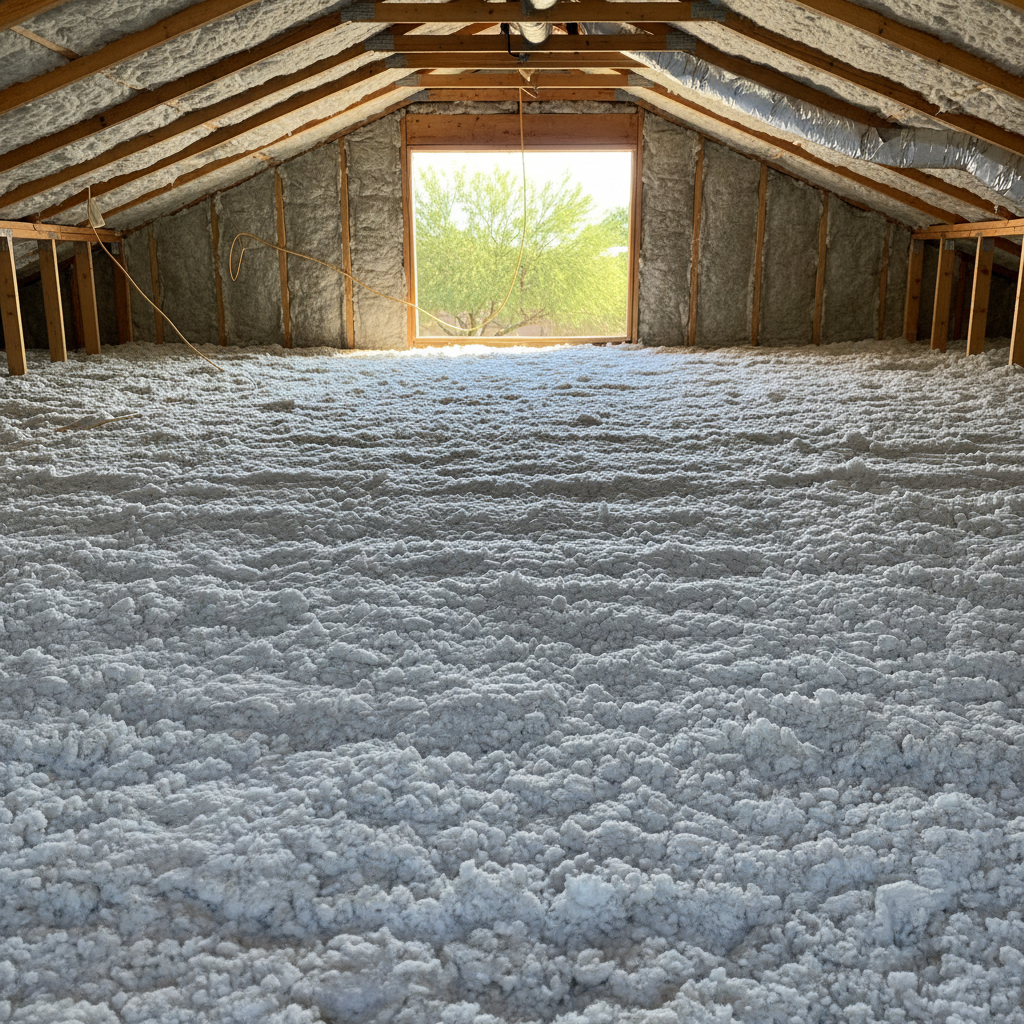
Alright, let's talk money. You're probably looking into blown-in insulation because your AC is running non-stop and your power bill looks like a phone number, right? Good call. Blown-in insulation, whether it's fiberglass or cellulose, is a really smart move for keeping your home cooler in the summer and warmer during our (brief) winter. But what's it actually going to set you back here in Mesa?
You'll hear a lot of folks say, "it depends." And, yeah, it does. But that's not exactly helpful, is it? So I'm going to give you some real numbers, based on what I see every day out here in places like the Dobson Ranch area or over by Red Mountain. We're mostly talking about attic insulation, since that's where blown-in really shines for most homes.
What Makes the Price Go Up or Down?
A few big things really push the cost one way or the other. You need to understand these before you even think about getting a quote:
- The Material Itself: For blown-in, you've got two main choices: cellulose and fiberglass. Cellulose usually comes from recycled paper, treated to resist fire. Fiberglass is, well, glass fibers. Generally, fiberglass costs a bit less per square foot than cellulose. But cellulose often has a higher R-value per inch, meaning you might not need as much of it to hit your target R-value.
- Your R-Value Goal: This is a huge factor. R-value measures how well insulation stops heat from moving. In Mesa, we're usually aiming for R-38 to R-49 in attics. Sometimes even R-60 if you're super serious about energy efficiency. The higher the R-value, the more material we'll be blowing in, and naturally, the more it costs. If you've got zero insulation up there now, jumping from R-0 to R-38 is a bigger job than just adding to existing R-19 to reach R-49.
- How Easy Is Your Attic to Get Into?: Is your attic a big, open space, easy to walk around in? Or is it a tight crawl, crammed with ducts, wires, and old boxes? The tougher it is to move around, the longer the job takes, and that means higher labor costs. Sometimes we even have to clear out old, crummy insulation first, which adds to the cost for removal and disposal.
- Square Footage: This one's pretty obvious. A 1,200 sq ft ranch house will cost less than a 3,000 sq ft two-story. We measure the floor area of your attic, simple as that.
- Prep Work: Before we blow in any new insulation, we often need to do some preparation. This might include sealing up air leaks around light fixtures, plumbing stacks, and attic hatches. This air sealing is absolutely critical; insulation alone won't do its best job if air is just sneaking past it. Sometimes we're also putting in baffles at the eaves to make sure your attic gets proper ventilation.
Realistic Cost Ranges for Blown-In Insulation in Mesa
Alright, let's get down to some actual numbers. Remember, these are averages for a typical Mesa home, not some custom mansion or a tiny shed. These prices generally cover material, labor, and basic prep like air sealing around common openings.
For blowing in new insulation (without needing to remove old stuff):
- Fiberglass Blown-In: You're usually looking at about $1.00 to $1.75 per square foot for an R-value of R-38 to R-49. So, for a 1,500 sq ft attic, that works out to roughly $1,500 to $2,625.
- Cellulose Blown-In: This tends to be a little more, around $1.25 to $2.00 per square foot for R-38 to R-49. For that same 1,500 sq ft attic, you'd be in the range of $1,875 to $3,000.
Now, if you need old insulation removed, that's an extra charge. Removal can add anywhere from $0.75 to $1.50 per square foot, depending on how much is there and how nasty it is (think rodent droppings, moisture damage). So, for our 1,500 sq ft example, tack on another $1,125 to $2,250 for removal.
So, a complete job, including removal and new R-49 cellulose in a 1,500 sq ft attic, could be in the ballpark of $3,000 to $5,250. This might sound like a lot, but the energy savings over just a few years — especially with our brutal summers — often means it pays for itself. Pretty cool, huh?
What Should Your Quote Include?
When you get a quote from Spray Foam Pros of Mesa, or any other reputable contractor, make sure it's super detailed. It should clearly spell out:
- The total square footage of the area that needs insulating.
- The exact type of insulation material (fiberglass or cellulose).
- The target R-value you're aiming for.
- Whether old insulation removal is part of the deal, and its cost.
- Any air sealing work that will be done (e.g., around top plates, can lights, attic hatch).
- Any necessary ventilation work, like installing baffles.
- Warranty information for both the material and the labor.
- A clear total price, with absolutely no hidden fees.
Don't Overpay: My Contractor Advice
You want a good job at a fair price. Here's how to make sure you're not getting ripped off:
- Get Multiple Quotes: This is Insulation 101, folks. Get at least three detailed quotes. Don't just pick the cheapest; really compare what each quote covers.
- Ask About Rebates: SRP and APS often have rebates for insulation upgrades. A good contractor will know about these and help you with the paperwork. It could save you hundreds!
- Understand the R-Value: Don't just ask for "more insulation." Ask what R-value they're suggesting and why. For Mesa, R-38 is the bare minimum, R-49 is better, and R-60 is top-tier.
- Check References and Reviews: See what other homeowners in Mesa are saying about them. Are they licensed and insured? That's non-negotiable.
- Beware of "Too Good to Be True" Deals: If one quote is drastically lower than the others, there's usually a reason. Maybe they're using less material, cutting corners on prep, or they're not even licensed.
Investing in good blown-in insulation is honestly one of the smartest things you can do for your Mesa home. It'll make your home more comfortable, your AC won't have to work so hard, and your wallet will thank you. Just make sure you understand exactly what you're paying for.